Magnetic field lines representing the earth’s magnetic field. Image from http://www.nasa.gov.
The earth generates a giant magnetic field. The magnetic field produced by the earth causes a compass needle to point north. Why does the earth have a magnetic field? Scientists agree it is the result of electrical currents generated in the earth’s core. Two different models have been developed to explain the origin and behavior of Earth’s magnetic field: the dynamo theory and the rapid decay theory.
In the dynamo theory, the convective (heat-driven) motion of electrically conductive fluid (liquid iron) in the earth’s outer core generates an electric current, which produces a magnetic field. This magnetic field interacts with the moving fluid to produce an additional magnetic field. These combined fields result in the earth’s overall planetary field. The rotation of Earth is what provides the needed motion to sustain the magnetic field. This theory is the most popular model of magnetic fields, and it allows a magnetic field to be sustained over long periods of time, even billions of years.
A young-earth creationist physicist, Dr. Russell Humphreys, developed another model of planetary magnetic fields based on the Bible. This model could be called the “rapid-decay theory.” The rapid decay theory assumes that the earth’s magnetic field is generated by decaying electrical currents in the core. According to Humphreys, the earth was initially created with all of its particle spins aligned, which produced a magnetic field. Once the spins become disoriented, an electric current would form, maintaining this strong magnetic field. Because of the electrical resistance in the core, however, the electrical current would decline over time, reducing the strength of the magnetic field over time. Thus, today’s magnetic field is simply a remnant of the initial magnetic field at creation. Interestingly, in order for this model to be correct, the earth must be no older than 8,700 years.
If we test these models using the scientific method, which model can we conclude is the stronger scientific hypothesis?
Mercury. Since the dynamo model depends on rotational speed, Mercury was not expected to have a magnetic field. As one article stated:
Because of the low rotation rate Mercury was not expected to generate a field.1
In 1974, it was found that Mercury did possess a magnetic field. Thus, the dynamo model incorrectly predicted the lack of a magnetic field on Mercury. The rapid-decay model, on the other hand, has no difficulty explaining the existence of Mercury’s field, since it predicts that all planets started out with magnetic fields.
The rapid-decay model also predicts that the strength of a planetary magnetic field decays over time. In 1975, the Mariner 10 spacecraft flew by Mercury and measured the strength of its magnetic field. In 1984, Humphreys predicted the amount by which Mercury’s magnetic field would decrease over time. In 2008, the field was measured again by NASA’s Messenger spacecraft, and that measurement appears to confirm the prediction of his model, at least better than the dynamo model.

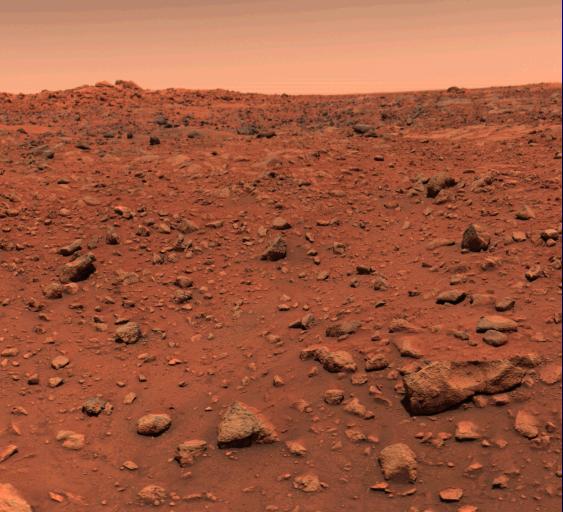
Photo of the surface of Mars, where evidence of a past magnetic field was found in its crustal rocks. Image from http://photojournal.jpl.nasa.gov/jpegMod/PIA00563_modest.jpg.
The moon and Mars. The dynamo theory predicted that Mars should have a planetary magnetic field,2 but it does not. In contrast, the rapid-decay model is consistent with the lack of a planetary field on Mars. In addition, the rapid-decay model predicted that Mars would show evidence of a prior magnetic field (evidence of a past magnetic field can be detected in remanent magnetization in crustal rocks).3 In 1999, this evidence of a past magnetic field on Mars was found, confirming Humphreys’s prediction from 1984.
The dynamo theory predicts that if a planet starts out with a magnetic field, that field should be sustained over long periods of time. Thus, the fact that Mars shows evidence of a past (i.e., crustal) magnetic field is surprising to dynamo theorists, as Mars would be expected to still have its magnetic field today if it had one at all in the past.
Since the dynamo model depends on rotation and the amount of conducting material in the core, the moon was expected to possess no magnetic field at any time in its history. However, evidence was found for a past magnetic field preserved in its crustal rocks, just as on Mars. Thus, the dynamo model incorrectly predicted the lack of any magnetic field in the moon’s past. On the other hand, the rapid-decay model’s expectations fit these observations perfectly, since it predicts that all bodies start out with a magnetic field, and that a body like the moon would lose its magnetic field rather quickly due to its specific properties. Thus, we would expect to find evidence of a past magnetic field in its crust if the rapid-decay model is correct.
Uranus and Neptune. When Humphreys developed the rapid-decay theory in 1984, the magnetic fields of two planets, Uranus and Neptune, had not been measured yet. Using his model, Humphreys predicted the strength of the magnetic fields of those planets. The predictions were on the order of 1024 J/T (joules/tesla) for both planetary fields. When NASA’s Voyager II spacecraft flew by the planets, they measured the magnetic fields of those planets, and the measurements confirmed Humphreys’s predictions to within an order of magnitude.
In contrast, the dynamo model initially predicted a weak or nonexistent magnetic field for Uranus. This is because the planetary dynamo is expected to generate much heat, which should be detectable as heat flow from the surface of the planet. However, Uranus has an extremely low heat flux. As a result, dynamo theorists recognized this a problem and tried to “adjust” the model when they began to see evidence for a magnetic field on the planet.4 Even after the existence of a magnetic field on Uranus was confirmed, dynamo theorists continued to try to reconcile these data with their models.5
Magnetic Reversals on Earth. There is strong geological evidence that the Earth’s magnetic field has reversed multiple times in the past. This means that at certain times in the past, a compass needle would have pointed south instead of north. Both the dynamo model and the rapid-decay model agree that the Earth’s magnetic field can reverse. However, the old-earth dynamo model predicts that reversals generally take place at a rate of once every 1,000 years or even tens or hundreds of thousands of years. The reversal itself is thought to take at least 1,000 years to occur. The rapid-decay model predicts that a reversal would happen as fast as once per week on average, during the Biblical global flood. In 1989, geologists examined thin lava flows that showed evidence of magnetic variation that took place within weeks.6 Further evidence for reversals happening in a few years were discovered later by other geologists.7
Which model predicted these data more accurately? Well, the young-earth model predicted reversals happening once per week. The data do not fit this prediction exactly, but it is close. The data from the two studies in Footnote 6 indicate that at the measured rate for the change in direction of the magnetic field, a full magnetic reversal could happen over a period of 60 days. Thus, the young-earth model was off by the following factor:
60 days / 7 days = ~8.57
If we are generous to the old-earth model and assume that reversals take place once every 1,000 years, we can calculate that its prediction is off by a factor of:
1000 years = 365,000 days / 60 days = 6,083
Thus, the old-earth model for magnetic fields was wrong by a factor of over 6,000 in its prediction! The young-earth model’s prediction differed only slightly from the data, by a factor of 8.57. Likewise, for the study in Footnote 7, the young-earth model is off by a factor of 180, and the old-earth model is off by a factor of between 285 and 5,780.8 Either way, the young-earth model’s predictions were far more successful than the old-earth model’s predictions in these instances.
In summary, the young-earth model of planetary magnetic fields based on the Bible and developed by Humphreys is consistent with current observations of the moon and planets’ magnetic fields. In addition, it has predicted certain data accurately before they were measured. In contrast, the old-earth dynamo model has incorrectly predicted the existence/non-existence and strength of some of the planets’ magnetic fields. Clearly, the young-earth model for planetary magnetic fields is a much stronger scientific hypothesis than the old-earth model. Once again, the data fit the young-earth view better than the old-earth view.
—————
1 Parker, E. N. 1983. Magnetic fields in the cosmos. Scientific American, 249(2):44-54 (August), p. 51.
2 Ibid, p. 52.
3 In his 1984 paper, Humphreys wrote, “Older igneous rocks from Mercury or Mars should have natural remanent magnetization, as the Moon’s rocks do.”
4 Smoluchowski, R. 1979. “Origin of the magnetic fields in the giant planets.” Physics Of The Earth And Planetary Interiors 20, no. 2-4: 247-254. Link. Torbett, M., and R. Smoluchowski. 1980. “Hydromagnetic dynamo in the cores of Uranus and Neptune.” Nature [London] 286, no. 5770: 237-239. Link. Smoluchowski, R. “The Magnetic Field of Uranus.” Bulletin of the American Astronomical Society, Vol. 10, p.577. Link.
5 Sabine Stanley and Jeremy Bloxham. “Numerical dynamo models of Uranus’ and Neptune’s magnetic fields.” Icarus. Volume 184, Issue 2, October 2006, Pages 556–572.
6 Coe, R.S. and Prevot, M., “Evidence Suggesting Extremely Rapid Field Variation During a Geomagnetic Reversal,” Earth and Planetary Science 92:292-298, 1989; Coe, R.S., Prevot, M., and Camps, P., “New Evidence for Extremely Rapid Change of the Geomagnetic Field During a Reversal,” Nature 374:687-692, 1995.
7 Bogue, S. W., and J. M. G. Glen (2010), “Very rapid geomagnetic field change recorded by the partial remagnetization of a lava flow,” Geophys. Res. Lett., 37, L21308, doi:10.1029/2010GL044286.
8 The reversals in Footnote 6 took place at the rate of 1 degree/week, or 1 reversal/180 weeks = 1260 days. 1260 days (measurement) / 7 days (young-earth prediction) = 180. For the old-earth model, 1000 years = 360,000 days (old-earth prediction) / 1260 days (measurement) = 285.7. If we use a maximum time of 20,000 years for a magnetic flip (e.g., see this article), the old-earth model’s prediction would be off by a factor of 20,000 years / 3.46 years (180 weeks for one reversal) = 5,780.